
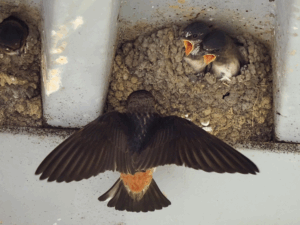
A Cliff Swallow tending to a nest in the Simon’s Rock colony. PHOTO BY LINDA MERRY
“When the swallows come back to Capistrano” is a phrase with a long history in US popular culture. It refers to a colony of Cliff Swallows located at Mission San Juan Capistrano in Southern California. The swallows’ return to the mission every spring has been inspirational to many Americans for over a century, including musician Leon René whose love ballad “When the Swallows Come Back to Capistrano” reached #4 on the pop music charts in 1940 and was re-recorded by Pat Boone, Guy Lombardo, and others. The phrase and song celebrate the idea that, no matter how many times the swallows leave, we can have faith that they will return.
Massachusetts is home to Cliff Swallow colonies as well. However, the swallows’ return here has become far less certain in recent years.
We have six species of swallow that breed in our state. All are voracious consumers of flying insects, including many that we humans consider pests. The Cliff Swallow is noted for eating insects of over 80 families, most of all species that gather in swarms, at times including large numbers of chinch bugs, boll weevils, and their relatives. Four of our six breeding swallow species form colonies, meaning that swallows of that type for miles around all return to the same spot several times a day to feed their young. This enhances their pest control value for anyone lucky enough to have a colony nearby.
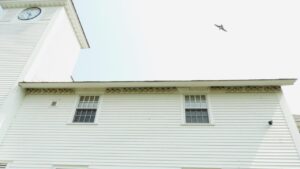
A Cliff Swallow swoops around the Rowe, Mass Town Hall where you can see the nest of its resident colony tucked up under the edge of the roof. PHOTO BY PAUL SIEVERT.
The Cliff Swallow is actually a relatively recent arrival to Massachusetts; the species was unknown here before approximately 1800. It increased rapidly from there, mostly due to agricultural changes to our landscape, and is thought to have peaked around 1870. Cliff Swallows’ nests are hollow globes of dried mud which the birds stick to vertical surfaces; these globes adhered nicely to not only natural cliffs, but also to many widely used 19th-century building materials. As we entered the 20th century, however, we began using different materials, and coatings of paint, to which the swallows’ nests could not adhere.
Modern building materials are far from the only contributor to the Cliff Swallows’ decline. House Sparrows, introduced to North America from Europe, steal the swallows’ nests, sometimes even killing their nestlings. More recently, huge declines in the biomass of flying insects have cascaded into declines of the birds that feed on such insects, including not only swallows but also swifts, nighthawks, and whip-poor-wills.
The Massachusetts Breeding Bird Atlas illustrates Cliff Swallow’s frightening decline in our state. During the first Atlas from 1974 to 1979, the species was fairly common from Worcester County westwards, and Essex County also had a healthy population. Even then, atlas contributors noted that many seemingly suitable breeding sites, particularly in the Pioneer Valley, were occupied by House Sparrows that had evicted the swallows. By the time the second Atlas was conducted, from 2007 to 2011, nearly all breeding colonies of Cliff Swallows had disappeared from Worcester County eastwards except for the northern third of Essex County and two locations in Middlesex County. Numbers in Hampshire County were down noticeably as well.
At the time of this writing, Massachusetts may have fewer than 10 Cliff Swallow colonies remaining in the state. The state’s Division of Fisheries and Wildlife (MassWildlife) has labeled them a “Species of Greatest Conservation Need”. To make matters worse, the state’s two largest colonies are facing potential destruction. The federal Migratory Bird Treaty Act protects the swallows from being directly harmed, meaning their nests cannot be destroyed during the breeding season when some of them contain eggs or chicks. But, once the chicks have fledged and the swallows begin their fall migration, rendering a colony site uninhabitable for the birds is completely legal.
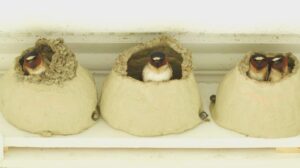
Three nests in the colony of Cliff Swallows living at the Rowe Town Hall. The second-largest colony in the state, these local birds are facing dire peril. PHOTO BY PAUL SIEVERT.
The state’s largest colony dwells at Simon’s Rock in Great Barrington, on the Daniel Arts Center. A count in 2024 tallied 95 active nests, with recent counts of individual birds exceeding 300. For many years, Simon’s Rock has been home to Bard College’s early college and high school programs, but Bard announced last year that they would be closing the campus, moving those programs to upstate New York, and selling the property. The Rock’s future owners, depending on their goals for the land, might decide to let the colony stay in place, or destroy it.
The second-largest colony in the state, in the town of Rowe, is facing even more dire peril. A colony usually averaging around 40 nests, estimated to include 20% of the state’s entire Cliff Swallow population, resides under the eaves of the town hall. The town’s government has decided to evict the swallows from the building after this year by installing structures to block the birds from constructing nests there. Their primary motivation seems to be the health risk presented by the swallows’ droppings, a risk frequently exaggerated by pest control companies trying to drum up business. A preliminary effort to found a new colony nearby failed to convince any swallows to relocate; if colony relocation is possible at all in Cliff Swallows it would require a multiyear project. Hopefully, the people of Rowe will decide to be patient and support the work necessary to keep their town’s swallow colony intact, rather than wipe out such a large percentage of our state’s population of a rapidly disappearing species.
The author would like to thank Mara Silver for her contributions to this article, and her work on behalf of swallows across western Massachusetts.
Joshua Rose (he/him) is a naturalist who lives in Amherst. He is vice president of the Hampshire Bird Club, Northeast Chapter head of the Dragonfly Society of the Americas and a contributing editor of the website bugguide.net; he regularly leads programs for local nature-oriented groups.
Earth Matters has been a project of the Hitchcock Center for the Environment since 2009. HCE’s mission is to educate and to inspire action for a healthy planet. Our Living Building and trails are open to all at 845 West St. in Amherst. To learn more, visit hitchcockcenter.org.
Share this page with friends!


















Hitchcock Center for the Environment
at Hampshire College
845 West Street | Amherst MA 01002 | 413.256.6006 | 413.253.2809 fax