
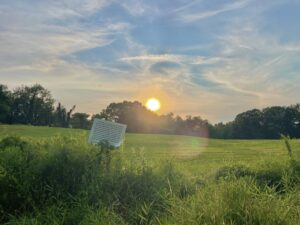
At the unofficial Northampton dog park, you’ll find a sign indicating a piece of local history that unites every community member. ALLIE MARTINEAU / For the Gazette
At the unofficial Northampton dog park on Burts Pit Road, tiny rocks trickle down the steep walking trail, followed by dogs of all sizes panting their way into the forest. As the trail levels out, the maple-colored canopy gives way to an open sky. Here, you’ll find a piece of Northampton history that unites every community member.
To your right, a field of orange jewelweed and purple loosestrife glows warm and dry; humming with insects and nesting birds. To your left, a sign reads: “This hillside is the final resting place of an estimated 181 former patients of the Northampton State Hospital … ‘Cemetery Hill,’ as this hay field was known, was used to bury the unclaimed bodies of patients who died at the hospital. The last burial took place in 1920. Please be respectful and walk around this field.”
This sign was installed as a project of the Northampton State Hospital Memorial Committee. They want to keep the site’s history from being forgotten.
The opening of Northampton State Hospital (NSH) in 1858 was part of a national movement to open state-run public hospitals, spearheaded and lobbied for by Dorothea Dix, a Massachusetts-raised social reformer and teacher, and Dr. Thomas Story Kirkbride, a psychiatrist known for innovating mental institutions. Dr. Kirkbride’s hospitals are known for their emphasis on light, fresh air, agricultural self-sufficiency and empowering residents to take on roles that contributed toward the community. Cemetery Hill and the surrounding land were part of the hospital’s farm; patients worked and walked that land as part of regular exercise.
For many patients, the hospital was home; where they lived, found family and friends, and received care. Many residents went home on the weekends, or used the hospital as an intermittent respite for their full-time caregivers. Some were able to outlive family members by living and receiving care at the hospital.
In theory, Dr. Kirkbride envisioned a nourishing environment to treat a range of physical, mental and emotional illnesses. In practice, the rate of institutional admissions quickly exceeded recommended capacity, leading to overcrowding. A hospital designed in the Kirkbride system was built to house 250 people, but by 1955 the NSH campus had grown to house 2,500 people.
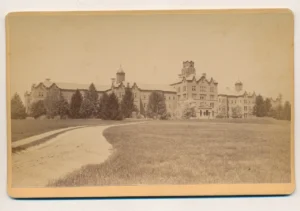
In the late 19th century, between one half and one third of patients who died at Northampton State Hospital were buried on the grounds. HISTORIC NORTHAMPTON’S ARCHIVE / Courtesy
The hospital housed a total of 65,000 patients before it closed, and conditions had been inadequate for decades. In 1976, the Northampton-based Center for Public Representation filed a class action lawsuit on behalf of several NSH patients claiming violations of their rights. The result was the Northampton Consent Decree, which mandated patients be gradually discharged and relocated to community-based programs and services. Global wars, economic depression, the Northampton Consent Decree, staff shortages, negative public opinion, general disrepair, overcrowding and deplorable treatment of patients were all factors leading NSH to close in 1993.
The property was then divided for a mix of uses. Cemetery Hill is nationally registered as part of the Massachusetts State Hospitals and Burial Grounds, and currently managed by the Smith Vocational Agricultural School. It was recently mentioned by the Massachusetts Special Commission for State Institutions in July 2024 as a state hospital cemetery that would benefit from additional research and interpretation.
Anyone who passed away at the hospital was a candidate for Cemetery Hill. Families had the option to pick up their loved one for burial in a family plot, but residents without family, or whose family didn’t have the ability to transport or bury them, were interred on campus. “In the late 19th century, between one half and one third of patients who died in the hospital were buried on the grounds,” according to the Massachusetts Department of Environmental Management.
The burial ground at Cemetery Hill was in use from the founding of NSH until 1920. Afterward, citizens who died in state hospitals, asylums or prisons not claimed for burial were permitted by new state laws (Chapter 113 of general law, or Chapter 77 of regular law) to be sent as cadavers to medical schools.
In a 1997 report by Elizabeth Kroon for the Department of Mental Health, she confirmed there are 181 former patients of the hospital buried there, and a further 413 hospital burials with unlisted or unclear location. Of these 594 people, there are 18 confirmed names gathered by independent researchers on public websites like Find A Grave.
One of the people buried at Cemetery Hill, Frances Loud, who died in 1885, moved into the hospital after his father and caretaker passed away. Census documents suggest, in the parlance of the time, that Frances was born with a learning disability due to a neurological or chromosomal difference that made him unable to live independently, but fully capable of contributing to the community. Frances couldn’t vote, but could read and write. He lived and worked with his parents on their family farm until 1853 when his mother passed, then another 30 years alongside his father. Frances’ brother was alive then, but married with young children, so their home was perhaps not the safest or calmest environment for cohabitating. He would have arrived at NSH with valuable agricultural skills, and was likely encouraged to put his experience to work for the betterment of the land and community in his nine-year stay.
When we speak of the hospital’s history in whispers, using outdated words like “lunatic” or “asylum,” it separates us from the humanity of its past residents. The idea that everyone who lived on Hospital Hill had a mental, physical or emotional disability ignores the wider scope of care offered. Many patients, like Josephine Villancoeur Monier, who died in 1905, were admitted to specialty wards that served people with specific illnesses like tuberculosis (TB) or pellagra. Josephine contracted TB while working at a textile mill in Holyoke. Poor ventilation, close working conditions and textile dust created the perfect environment to foster and spread respiratory illness throughout the mill.
Emma Petterson, who died in 1905, was 38 at the time of her death, the same age as the older sister writing this article. Emma suffered from acute kidney issues resulting in emergency hospitalization, and was a resident at NSH for a brief 10 days. Because she was a widow from Sweden, employed in Northampton as a housekeeper, there was presumably no one to handle her post-mortem care, and so she was laid to rest on Cemetery Hill.
As an employer, NSH had a significant economic impact on the city. According to “Images of America: Northampton State Hospital,” a nurse’s training program began in 1898, and much of the staff lived and worked on campus. Some staff worked at the hospital for their entire lives, raising families on site, and in many cases, creating a legacy of hospital employees.
The individuals buried at Cemetery Hill were western Mass. neighbors, family and friends, business owners, farmers and veterans — people who knew the people who loved and raised us. As residents of western Mass., and the city of Northampton, we all have a connection to this place and live with its legacy. Most of us are only a few degrees of separation from its staff, residents or in the authors’ case, both.
The authors of this column, Allie and Brianna, have a deep family history in western Mass. and personal connection to NSH. Our great-, great-grandparents met when they were both employed there. Alfred “Fred” Cooper was a runaway farm boy from Heath and Jeannie Joyall was a Scottish immigrant. Once married, Fred and Jean Cooper moved to a farm in Heath and had three children. According to our great-grandmother, her mother died in 1925 at the age of 37 in the Rutland Sanitorium, a hospital specializing in the treatment of TB. Eight years later, Fred developed cancer at 61. Without the support of family, he checked himself into the Tewksbury State Hospital, where he succumbed to his illness. He is buried at Tewksbury Hospital’s former cemetery, “The Pines,” now located in a wooded area distinguished by numbered metal markers. This cemetery is now maintained by volunteer groups such as “Save The Tewksbury Hospital Pines Cemetery,” a Facebook group with 1,000-plus members.
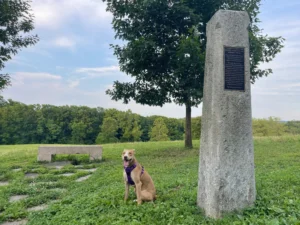
A photo of the author’s dog on the beautiful peak of Cemetery Hill, at a memorial installed for rest and reflection. ALLIE MARTINEAU / For the Gazette
The geology of Northampton’s Cemetery Hill is unusual. The hill is an accumulation of sediment, part of a historic delta formed by Glacial Lake Hitchcock. Hitchcock Center in Amherst, which publishes the Earth Matters column you’re reading, is named in part for the lake, which at one point stretched from upper Vermont to southern Connecticut. Co-Executive Director of Historic Northampton Laurie Sanders notes the hill is one of the few parts of the property that’s sandy, which made it ideal for use as a burial ground. The sandy dirt allowed for easy digging and a low water table, ensuring bodies would not rise to the surface over time.
What does a cemetery become when its residents are beyond memory? A burial ground meets the last need of the deceased: a place to decompose that will not threaten the health of the community. With this need met, the space becomes a place — both real and unreal, of the past and present — for the living to cultivate, explore, gather, rest and reflect.
Many of our modern ideas about cemeteries are rooted in the Victorian era. Victorian cemeteries were planned to meet myriad community needs — burial and memory, yes, but also as outdoor sculpture parks and public gardens. If we’re looking for models of cemetery decorum, the Victorians had it: when visiting a cemetery, bring your curiosity and appreciation for the beauty of the space, but keep your steward’s hat in hand. Take responsibility for picking up trash, righting signs and educating your fellow visitors on what makes this place special. Stay on designated walking paths and don’t move rocks or other materials in the fields and surrounding woods.
When you visit this place, give yourself a moment to take in Cemetery Hill. Imagine the space when it was utilized: rectangles of disturbed ground each slowly blending back into the topography as the grass returned. Some graves were originally marked with field stones or small rectangular monuments — perhaps you have loved ones who remember playing around them as children. Visualize the flowers and pebbles left upon graves by hospital residents paying their respects to lost friends. See generations of people walking, playing and tending to the hill under thousands of orange sunsets.
Historic cemeteries are some of our state’s first conservation land, and this space is a gift. Our direct and indirect connections to Cemetery Hill call on us to honor the individuals interred there — both named and unknown — by taking responsibility for the land’s stewardship and preserving it for future generations. It is the presence of Frances Loud and his fellow cemetery residents who have ensured that this land is set aside for all of us to enjoy. All that once was sits just below the surface, in the sandy soil of the Lake Hitchcock delta.
Thanks to Smith Vocational Agricultural School and all who care for Cemetery Hill, the surrounding land and those laid to rest there. Further suggested reading is “The Life and Death of Northampton State Hospital” by J. Michael Moore and “Images of America: Northampton State Hospital” by James Michael Moore and Anna Schuleit Haber. You can explore research online by the Northampton State Hospital Memorial Committee and contact Historic Northampton with further questions.
Allie Martineau (they/she) is the comms and marketing coordinator at Hitchcock Center. They’re a writer, artist, and illustrator raised in the Connecticut River Valley with their sister Brianna McCormick. Brianna (she/her) is a multimedia artist and historian currently working at Historic Oakwood Cemetery in Raleigh, North Carolina.
Earth Matters has been a project of the Hitchcock Center for the Environment since 2009. HCE’s mission is to educate and to inspire action for a healthy planet. Our Living Building and trails are open to all at 845 West St. in Amherst. To learn more, visit hitchcockcenter.org.
Share this page with friends!


















Hitchcock Center for the Environment
at Hampshire College
845 West Street | Amherst MA 01002 | 413.256.6006 | 413.253.2809 fax