Classroom Programs
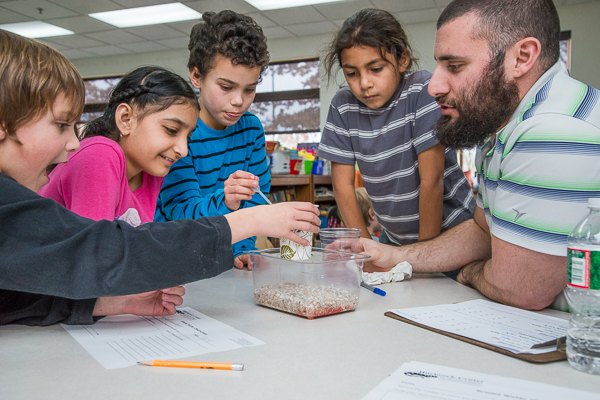
Our classroom programs use the scientific process, live animals, and hands-on activities to help students learn about a wide range of life, earth, physical and environmental science topics. In addition to the classroom programs listed below, a number of our field trips can be adapted to a one-hour classroom program including our Habitat Studies, Animals in Winter, Tree and Me, Forest Ecology, Insect Investigations, Life in a Pond, and Pond Ecosystems. All programs meet Massachusetts Curriculum Standards.
Program Fee
45 Minutes $195 + travel fee – Preschool & Kindergarten Programs
60 Minutes $250 + travel fee – K-8 Programs
90 Minutes $295 + travel fee – Engineering Challenges
For help selecting the best program for your class, view our Scope and Sequence Chart to find field trips and classroom programs listed by grade level and science discipline.
Classroom Programs
Rainwater Capture Challenge
Grade levels 3-5
Massachusetts Curriculum Standards
In this activity, students will be presented with a real world problem – a shortage of water. They are challenged to create a model of a roof to capture and store rainwater and snowmelt. They must meet certain criteria and work within the constraints of materials, time and cost. Students will test and compare solutions, and discuss improvements to the model.
Water Filtration Challenge
Grade Levels 3-5
Massachusetts Curriculum Standards
Clean water is essential for human life. Students will be presented with a situation where a human practice has polluted drinking water. They will choose appropriate materials to design and build a water filtration system. Students will compare different systems and discuss improvements to their designs.
Local Animals and Their Adaptations
Grade Levels: 3–4
Massachusetts Curriculum Standards
How do animals survive in the wild? Meet some live and mounted local animals, and learn how their biology and behavior helps them to survive in their habitat. An educator will bring animals from forest, field and wetland habitats to your classroom, and students will learn about the amazing diversity of life in our area.
Busy Beavers: An Engineering Design Challenge
Grade Levels: 4-6
Massachusetts Curriculum Standards
Beavers are often called “nature’s engineers” due to their remarkable ability to change their habitat. This keystone species has amazing adaptations that enable it to survive and thrive, especially in the northeast, and students may have seen evidence of beavers in their community. This lesson aims to introduce students to beaver adaptations and then focus on the engineering aspect of building dams. After learning why and how beavers build dams in the wild, students will design their own dam using provided materials, work with a team on a unifying design, and build, test, re-design, and re-test their dams.
Wind Energy: The Turbine Design Challenge
Grade Levels 4-6
Massachusetts Curriculum Standards
Students will investigate how wind can generate electricity using fans and small motors. They will view photos of various wind turbine designs to inspire them in creating their own prototype. Students build and test their models by measuring electricity generated. They then evaluate design features and plan for re-design.
Energy Investigations
Grade Levels: 4, 7-8
Massachusetts Curriculum Standards
Energy is both in the news and in the Massachusetts Framework. This award-winning curriculum will help you and your students understand where our energy comes from in Massachusetts and how it is generated. You will explore both renewable and non-renewable energy sources and generate electricity using a simple generator, solar collectors, mini-wind mills (turbines), and water wheels (turbines). There is an emphasis on sustainable technologies and carbon emissions, and making the connection between human activities and climate change.
Share this page with friends!