
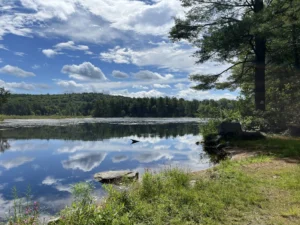
Historic dams can sometimes have beneficial impacts on surrounding wildlife, plants, and waterways, as with the dam that created Ames Pond in Shutesbury that sustains a rare natural bog ecosystem. / PHOTO BY KESTREL LAND TRUST
Two centuries ago, the rhythmic creak of wooden waterwheels was likely a familiar sound along rivers and streams in the Connecticut River Valley. Mills powered by the energy of flowing water were hubs of early European colonial communities that provided the necessities of everyday life. There were sawmills for cutting wood, gristmills for grinding grain, and textile mills for making cloth, among other types of goods. These mills also had a significant influence on the environment because they required damming of the streams that provided their power.
By the 1800s, thousands of dams had been built across New England’s waterways, transforming the landscape and fueling an economy based on waterpower. These dams didn’t just move millstones—they shaped entire ecosystems. Wetlands were flooded, channels were redirected, and human-made impoundments expanded on natural beaver ponds. Ironically, beavers—New England’s original dam builders and water engineers—were nearly exterminated during this period, their fur sold to meet European fashion demands.
Today, most of these dams that still exist are aging relics, no longer serving their original purpose. As they deteriorate, dam structures must be monitored for safety risks. And, we now understand the ecological drawbacks too: dams impede the movement of fish and other aquatic life, increase water temperatures, and disconnect habitats. Climate change has amplified these threats.
But historic millponds formed by dams can provide ecological benefits as well, with the creation of new aquatic habitats. The open water of a pond can support fish, ducks, turtles, and other wildlife and plants that would not otherwise exist in that landscape. Today these areas often provide scenic and recreational opportunities in our communities like swimming, kayaking, and fishing. All of these considerations make the maintenance or removal of historic dams an important decision with its own range of impacts, both positive and negative.
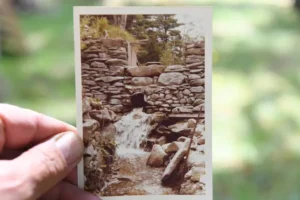
David Brown, who has lived next to the dam at Dudleyville Pond in Shutesbury since 1972, holds an old photo of the dam. / GAZETTE FILE PHOTO Credit: STAFF PHOTOS/PAUL FRANZ
In Shutesbury, the fate of two historic millponds tell different ecological stories about the legacy of old dams. A dam built in the 1830s by S. F. Dudley on a small tributary of the Sawmill River created Dudleyville Pond and powered a sawmill for several decades. The pond was later enjoyed for year-round recreation by many generations. However, by the 1990s, the privately-owned dam was determined to be a safety risk and the water level was lowered to reduce the risk of a breach. The dam wall and pond remained intact, though the area of open water was greatly reduced. Finally, under a state emergency order, in the summer of 2024 the dam was removed by state and nonprofit partners.
All of these human modifications reshaped the land repeatedly over the centuries. Before the dam was built, the area supported a streamside forest for thousands of years. After the dam was installed, the pond supported aquatic plants, whose photosynthesis helped drive the area’s ecology. Then in the past decade as the water level was lowered, the newly exposed mudflat allowed a marshy meadow to emerge.
When the dam was demolished last year, the remaining waters released in a rush, revealing a fresh stretch of rich mudflats. Soon, the exposed “muck” teemed with life—great blue herons and migrating sandpipers foraged along the mudflats for newly exposed aquatic food to power their journey south.
As the brook has begun to cut its new path through the sediment, long-buried rocky cobbles have emerged as it returns to its former status as a cold-water stream. The hope is that it will once again provide habitat for brook trout and other species that can’t tolerate warmer waters. As the mudflat continues to dry, the area has transitioned into a marshy meadow, providing critical habitat for other types of wildlife. Much of the meadow may ultimately support tree seedlings and eventually become a forest once again.
The 200 acres around Dudleyville Pond is now owned by Kestrel Land Trust and permanently protected as wildlands, where natural processes will play out with minimal human management. After the decline of the early fur industry, beavers have fortunately returned to Western Massachusetts as a critical component of our ecosystem. It’s quite possible, then, that beavers will build a new dam along this stream not far from the former dam wall, which was built at a natural “pinch point” in the landscape—the most efficient location for a dam whether built by beavers or humans. If they do, the water level will likely be much lower than under the human-made dam, yet the flooding would again reshape the land through natural forces.
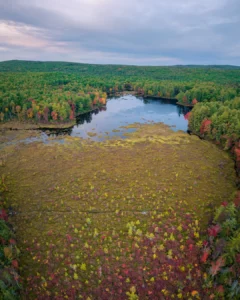
An aerial view of historic Ames Pond with its adjoining bog and forest at Kestrel Land Trust’s Bright Water Bog Nature Retreat in Shutesbury. / PHOTO BY JAMIE MALCOLM-BROWN
In contrast, just a few miles away at Kestrel’s Bright Water Bog Nature Retreat, a different plotline has been written. This site, also in Shutesbury, retains a historic dam built during the same era as the Dudleyville dam, but this dam is still considered structurally sound.
Behind the dam lies a shallow pond, frequented by beavers and a range of other wildlife like moose and bear. The historic pond is surrounded by several acres of sphagnum moss, wild cranberry, pitcher plants, cotton grass, and other bog-specialist plants that in turn support species like rare dragonflies that depend on this type of wetland. Though it’s likely that beaver dams were present here prior to colonist presence, the stable water level supported by the dam has allowed this rare bog community to develop and sustain itself over time, while other natural bogs throughout New England have been lost. The conservation area is now open to the public with extensive boardwalks that invite you to explore and appreciate this unique ecosystem.
The building of dams, like all human activities, has both short and long-term impacts on surrounding wildlife, plants, and waterways. Together, these two dams tell a story of past and present, of industry and ecology, and of the decisions that shape our landscapes. To maintain the healthy living systems that we all depend on, we must learn from these stories and make intelligent decisions about our actions.
Lee Halasz (he/him) is a conservation manager with Kestrel Land Trust, and lives in Pelham. He has been closely involved in the ecological realm his whole life, and became associated with Kestrel soon after moving from Australia thirteen years ago. He loves the local landscape, but is still working on loving winter!
Kari Blood (she/her) is community engagement director with Kestrel Land Trust and lives in Hadley. She has worked for and volunteered with land trusts in upstate New York and the Connecticut River Valley for almost 20 years, inspired by her love of wildlife and birds.
Earth Matters has been a project of the Hitchcock Center for the Environment since 2009. HCE’s mission is to educate and to inspire action for a healthy planet. Our Living Building and trails are open to all at 845 West St. in Amherst. To learn more, visit hitchcockcenter.org.
Share this page with friends!


















Hitchcock Center for the Environment
at Hampshire College
845 West Street | Amherst MA 01002 | 413.256.6006 | 413.253.2809 fax